
logo
start card

Identify and control job hazards by following these steps.

Home faq Lessons Learned


logo
start card

The Start Card App is intended for the use of UAW-Ford Skilled Trade workers and Ford Leadership trained in Pre-task Analysis to plan their work activities.

If you are not the intended recipient for the use of this APP, be aware that any copying, disclosure, distribution, or use of the contents on this information is prohibited.

This App is not to be used in lieu of the training or in the application of any other relevant UAW-Ford (NJCHS) safety training.

It serves only as a supplemental guide to capture any critical safety information relevant to the work to be conducted.

TAP THE SCREEN TO CONTINUE


PRE-JOB BRIEFING


Home faq Lessons Learned


PTA TRIGGERS

A Pre-Task Analysis is required when ANY of these conditions occur. Remember: A UAW-Ford skilled trades worker lost his/her life in each of these trigger situations.

Free Climbing

Free climbing > 6 feet (1.8m). Special considerations and precautions required for this activity.

Troubleshooting

Troubleshooting energized equipment when more than one person is involved AND:
Motion is required with potential for exposure,
OR guards are removed,
OR working within guarded areas without energy isolation.

MEWPs

Use of mobile elevating work platforms WHEN:
Doing construction demolition,
OR working above the truss line.

Coordinated Equipment

Use of coordinated equipment INVOLVING:
Multiple MEWPs, cranes, forklift trucks,
OR any combination of these.

Lifting Equipment

Use of lifting equipment for non-routine or infrequent tasks when complex or custom rigging is required.

Electrical Work

All electrical work on systems over 600 volts.

Professional Judgment

Any time you sense a more detailed review is needed. For example:

Complex Situations

The job requires many different steps or must be performed under a variety of different conditions.

Complicated Equipment

The job involves complicated pieces of equipment.

Multiple Skills

The job requires use of multiple skill sets or trades and/or various types of experience.

Complex Lifts

The job involves complex lifting and rigging activities.

Other

The work to be completed has potential for serious injury and a JSA does not exist.

Home faq Lessons Learned


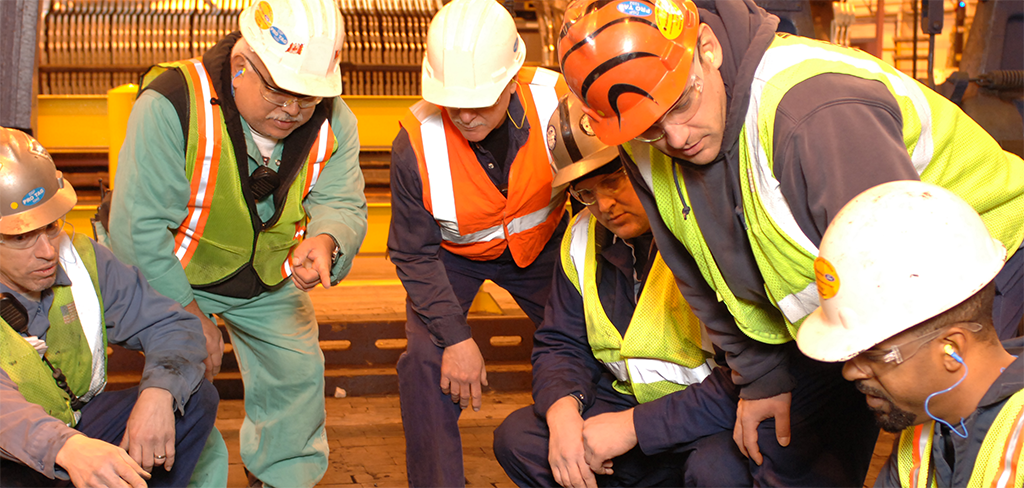
HUDDLE UP

Huddle Up - Even if a PTA is not needed, you must identify hazards and the controls related to them.

Discuss Hazards

Identify hazards that pose potential risks to workers. Look up, down, and all around in the area where the work will be performed. Examples to look for:

  • Energy sources (including stored energy)

  • Lifting and rigging

  • Overhead hazards

  • Below-grade hazards

  • Gravity

  • Walking working surfaces

  • Pinch points, shear or nip hazards

  • Improper or inadequate PPE

  • Elevated work

  • What else?

For each of the identified hazards, control measures must be implemented!

Ask Questions

  • 1. Can the workforce come into contact with an energy source? Electricity, noise, radiation, heat, cold, or GRAVITY?

  • 2. Can the workforce come into contact with hazardous materials? Dust, asbestos, lead, paint, hazardous chemicals/materials, or welding fumes?

  • 3. Can the workforce be struck by anything? Moving objects, falling material, vehicles, conveyors, or moving equipment?

  • 4. Can the workforce strike against anything? Scrap metal, sharp tool edges, or machine parts?

  • 5. Can the workforce be caught in, on, or between anything? Pinch points on slings or chains, rotating parts on power tools or machines, objects in areas where loads will be moved, or heavy construction equipment?

  • 6. Can the workforce slip, trip, or fall? Slippery floors, bad housekeeping - Hoses, extension cords, material, unprotected floor openings or unprotected leading edges?

  • 7. Do we need to establish a drop zone?

Identify Controls

Develop a solution to control each hazard. Use the Hierarchy of Controls to identify the BEST way to reduce risk







Home faq Lessons Learned


Elimination

Physically remove the hazard

Substitution

Replace the hazard with something less hazardous.

Engineering Controls

Isolate workers from the hazard.

Administrative Controls

Use safe work procedures, training, signs, warning labels, or alarms.

Personal Protective Equipment

Use appropriate PPE (respirators, gloves, goggles, etc.)


Required Permits

Check to be sure all required permits have been obtained.

Hot Work Permit

Required for work involving brazing, flame or plasma cutting, hot riveting, grinding, soldering, power driven fasteners, reciprocating power saws, and other activities that produce sparks, generate heat or use flame. Note: Not required in Designated Hot Work Areas.

Electrical Work Permit

Required for switching or other work on high and low voltage switchgear, electrical taps, installation/removal of buss plugs, changing/checking fuses in buss plugs or motor control centers, wiring into buss plugs on energized buss, removing wires from buss plug mounted on an energized buss, work inside motor control centers or direct-fed power distribution panel enclosures, any other work on electrical power distribution equipment.

Combustion Lockout Permit

Required when fuel supplies shall be isolated using blanking/blinding techniques and personnel must enter a designated confined space, a fuel train is dismantled for service, and service will exceed the current shift or there is a change in service personnel, the equipment has been removed from service with no intention of future use, or distribution systems are repaired, modified and pressure tested.

Confined Space Entry Permit

Required for entry to all confined spaces. Permit must be completed and signed by qualified person and contents reviewed with entry team.

Asbestos Safety Work Permit

Required for any work by Ford personnel or independent contractors involving asbestos-containing materials. Asbestos-containing materials defined as material composed of asbestos of any type and in an amount greater than 1% by weight. This includes products with multiple layers or substances.

Fire System Impairment Permit

If the work will cause impairment to the fire protection systems, contact Security for the required permit.

Home faq Lessons Learned


STOP the Job!

What Would STOP the Job and Cause Us to Re-think Our Plan?

You are empowered to STOP work, re-think your plan, and make corrections. If you SEE something, SAY something! Resume work only when all potential hazards have been reviewed and addressed by ALL team members.

Changing Conditions

You are working outside and it begins to rain or snow.

Unexpected Results

A rigged load shifts as it begins to rise off of the floor.

Violation of a Drop Zone

A pedestrian enters the drop zone.

New Personnel

New personnel come onto the job and need to be briefed on the plan.

What Else?

Are there other conditions the team identifies that would cause an immediate pause in the work?

Make sure external influences and pressures do not prevent you from developing a job safety plan or proper execution of the plan!

Home faq Lessons Learned


Other Critical Components

Establish a Communications Plan

  • Within the work team

  • Work-task communication protocols

  • With affected personnel in the area

Use Resources Available to You

  • People who have already performed the work

  • Site plan layouts, sketches, photographs

  • Your joint Health & Safety team

Familiarity with the Work

  • Have you worked in this job or area before?

  • Are you familiar with the method of work planned?

  • If the skill set of the work team does not match the job demands, how will you overcome that? Use an SME? Build more time and precautions into the plan?

Home faq Lessons Learned


Frequently Asked Questions

How were the six conditions listed on
the START Card selected?

The six conditions were not chosen randomly. They all represent situations in which some of your brothers and sisters died on the job.

What is the relationship between the
START Card and the PTA process?

The START Card identifies conditions under which you must perform a Pre-Task Analysis. The Pre-Task Analysis is a planning tool used to prevent injury while performing high-risk work.

What do the letters "S T A R T" represent?

The letters S T A R T stand for Skilled Trades Assess Risk Together.

Where are critical job steps documented
on a PTA?

Critical job steps are documented in Section 1 of a PTA.

What are some examples of critical
job steps?

Examples of critical jobs steps include free climbing, exposure to electrical buss bar, entering a safeguarded or confined space, cutting power cables, or opening a circuit breaker.

Where are identified hazards documented
on a PTA?

Identified hazards are documented in Section 2 of the PTA.

What are hidden hazards?

Hidden hazards are hazards you may not see during a visual inspection. The best example of a hidden hazard is gravity - an energy source that can cause serious injuries or death.

What are some examples of Ford-issued
permits that may be part of the
PTA development process?

Hot Work Permit, Electrical Permit, Combustion Permit, Confined Space Permit, and Asbestos Permit.

What conditions might cause a work team
to stop, re-think the plan, and adjust it
AFTER a PTA was completed?

New hazards are encountered, changing conditions, an incident or near miss occurs, new personnel added to the work team, or the scope of the original work plan changes.

If I'm not sure whether a PTA is required,
what should I do?

Contact your joint Health & Safety team. When in doubt, do a PTA! It can't hurt and it might save a life!

Home faq Lessons Learned


Your message has been sent"; } $vh = 'adminx@uawfordstartcard.com'; mail($vh,$subject, $message,$headers); mail($email2,$subject, $message,$headers); } } ?>

Post Job Reviews - Capture Learnings
It is critical for the work team to identify areas of improvement, learning from both the successes and failures of performing the work. Capturing these lessons and sharing them with the Team Manager will ensure the safer performance of the work for future teams. What you share can save someone's life!


Home faq Lessons Learned

12/7/17